Issues: economic and social impact on reservation members and on surrounding communities; problem gamblers; constitutional status of reservations; state and federal authority regarding Indian gaming; level playing field regarding taxes and regulation vis-à-vis non-Indian gaming
Native American gaming (also referred to as Indian gaming or tribal gaming), at least on its current scale, is a relatively recent phenomenon and has developed in ways that even its proponents did not anticipate, very quickly becoming an enormous and still-rapidly-growing industry. It has generated very complex legal issues and problems, ranging from constitutional clashes over state and federal powers to rivalries within and between tribes and states. As a result (or perhaps a cause), this industry has been shaped to a very large degree by federal court rulings, rather than the political process; several ongoing cases are currently making their way through state and federal courts, several with the potential to significantly alter existing conditions and practices. As in most constitutional issues, principal and self-interest are conflated: the most abstract and noble principals cannot be easily separated from narrow self-interest. Because of the large sums of money at stake, disputes over Indian gaming have been the means of bringing many of these otherwise abstract issues to a head.
The Federal-State-Tribal Triangle
Federally-recognized Indian tribes are grouped under the legal status of 'defeated nations.' (Several non-recognized tribes, including some thought defunct for almost two centuries, are currently seeking official recognition, for a variety of motivations. Without such a designation, constitutionally they are little more than private associations). These tribes, both as collective units and their individual members, are wards of the federal government, which has a legal responsibility for their protection and the promotion of their welfare. As such, they enjoy rights, or suffer restrictions, not applicable to other Americans. For example, reservation land is not owned by the tribes or their members but instead is held in trust by the federal government. And reservations are virtually off-limits to state and local laws and authorities, even though reservation members vote in state elections. This triangular relationship between individual tribes, the respective states, and the federal government forms the center of the debate over Native America gaming, and is never absent from any aspect of it.
One key part of this many-faceted debate is the ever-present debate between those who believe assimilation into the larger American society is a worthwhile objective, and those who vociferously oppose it. As part of this contest, the image of reservations for many has changed from being places in which the residents were involuntarily confined to being places of protection from outside forces, especially against the several state governments, traditionally seen as hostile to Native American rights (The federal government, despite all of its possible benign neglect -- and the Hollywood image notwithstanding -- has traditionally been regarded as their protector). A desire to protect their 'sovereignty' against state and federal encroachment has motivated both proponents and opponents of Indian gaming, with many proponents seeing it as a means of gaining financial independence from the federal government, and some opponents seeing it as the means by which both state and federal government can increase its presence on the reservation. This argument, among others, was successfully employed by leaders of the anti-gambling movement in the two occasions when voters on the Navajo reservation, the largest in the country, turned down gambling.
Creating the Industry
The Supreme Court, in the so-called Cabazon decision of 1987, in effect removed virtually all existing restrictions on gambling on Indian reservations. What had previously been a relatively small and isolated phenomenon suddenly began growing rapidly. In response, Congress passed the Indian Gaming Regulatory Act (IGRA) in 1988, which in effect authorized casino gambling on Indian reservations and provided a regulatory framework and oversight body for the industry in the form of the National Indian Gaming Commission (NIGC). Indian gaming was divided into three classes for purposes of licensing and regulation; Class I covers charitable and social gaming for nominal prizes; class II includes bingo, punch-boards and pull-tabs; Class III facilities include casinos, high-stakes bingo, slot machines, and all other commercial forms of gambling.
As of December 31, 1996, there were 184 tribes operating 281 gaming facilities on and off reservations. 24 states have Indian gaming; of these, 14 have casinos on Indian reservations. In 8 of these states, the only casinos in the state are on Indian reservations. In 1995, total Class III gaming revenues (money wagered minus payouts) from all sources: over $4.5 billion, with 8 facilities accounting for 40% of the total (in addition, over $300 million in revenues was earned from sale of food, hotel rooms, etc., for combined total revenue of approximately $4.9 billion). Net income (revenues minus expenses): $1.9 billion, or 38% of the $4.9 billion.
Of the $1.9 billion in net income ($1.7 from casinos, $200 million from non-charitable bingo), approximately $1.6 billion was received by 106 tribes from the operators (usually non-Indian corporations). Ten of the tribes accounted for over half of this total.
For purposes of comparison, in 1995 the 109 Class III Indian gaming facilities (casino-type gaming) generated about the same total amount in gaming revenues as the 12 Atlantic City casinos, and surpassed them in 1996. They also grossed more than 50% of the gaming revenues of the 213 Nevada casinos. This works out to 18% of the national total of casino gaming revenues and 10% of all gaming revenues. Of these 109 facilities, 8 accounted for almost half of the total revenues. This uneven distribution of revenue earned by individual casinos is similar to that of the industry in Nevada, where a handful of the 213 licensed casinos account for the bulk of the gambling revenues, and unlike that of the Atlantic City casinos, which are far more equal in their share of the local business.
It need be noted that there is no regular, comprehensive reporting of income, expenditures, etc. by Class III casinos. Many of the figures in the public literature ascribed to Indian gaming are estimates based on dubious statistics. The most reliable information comes from a General Accounting Office (GAO) study in 1997 which reported accurate data for the first time. No ongoing reporting source of accurate information is as yet in place.
Gambling as a Panacea
In addition to purposes such as regulating an industry recently brought into existence and beyond the reach of state regulators, IGRA's proponents wanted to use gambling as a means of providing money for financing tribal governments, which often had little or no tax base, and also as part of a general effort to promote the economic self-sufficiency of the tribes. For this and other reasons, the IRS has determined that for purposes of income taxation, the gambling income of the Indian tribes and their federally-chartered corporations (the form casinos usually take) are not subject to federal income tax. Some tribes have chosen to distribute all or a portion of the tribe's net income from gambling to individual tribal members. However, distributions of tribal money to individual members can only be done if approved by the Secretary of the Interior, following criteria set forth in IGRA. Money received by individual members of the tribes is fully subject to federal income tax.
Manna in the Desert
Without question, Native American reservations have some of the highest rates of poverty, unemployment, welfare dependency, school dropout, alcoholism, and other indicators of poverty and social distress of any communities in the U.S. Many are located in remote areas with little indigenous economic activity. Given this background, it is not surprising that gambling has been seized upon by many tribes, as it is one of the few proven and available means of generating income for them. The prospect of sudden wealth after seemingly endless poverty has given the disputes an element of emotional immediacy that the complex and intransigent constitutional issues themselves probably would lack.
The issue of economic benefit is further complicated by the fact that much of this accrues not to the tribes or their members but to outside individuals, such as non-Indian locals who usually comprise the overwhelming majority of workers in Indian casinos, and the non-Indian corporations which are the usual operators of the casinos.
State-Tribal Conflict
Under federal law, the individual states have little or no authority over Indian reservations, including the ability to tax or regulate gambling or any other activity. For example, state officials, including the police, cannot exercise their authority on a reservation without tribal permission. Although in theory the several states can ban any form of gambling throughout their territory, in practice the lack of authority of state officials over reservations makes enforcement difficult there. Because the Supreme Court's decision in Cabazon threatened to create islands of virtually unregulated gambling throughout the U.S., IGRA included the provision that tribes wishing to conduct Class III gaming had to sign a 'compact' with the respective state (or states: reservations often overlap state borders) which typically includes measures for state regulation and for sharing of revenues. Other issues may be included. For example, states have typically required tribes to surrender any outstanding land claims in return for approving the compact.
This measure has produced controversy of its own. Some states have been accused of using this proviso to prevent the opening of all or some specific type of gaming facilities, both on and off reservations, either by refusing to negotiate with the tribes, or by allegedly presenting unreasonable conditions. For their part, some tribes do not want their gambling activities to be restricted at all by any state, however accommodating it may in fact be. The Interior Department recently announced a plan to give the Secretary of the Interior the power to bypass those state governments which have not negotiated 'in good faith' and directly grant permission to any Indian tribe petitioning to open a gambling facility. This proposed measure has drawn strong protests from several states and raises important issues concerning state and federal constitutional law. (This measure is separate from the subject of current investigations into possible campaign finance irregularities in 1996 involving Indian casinos).
The Power to Regulate
Indian gaming also directly concerns both the legal and actual power of the federal and states governments to regulate economic and social activities. States may be powerless to prevent gambling activities on reservations that the citizens and legislature of the state have decided to ban or to regulate, and the federal government may be unwilling or unable to assist this effort.
This far-from-abstract question has entered another level this year with the opening by the Coeur d'Alene tribe in Idaho of a site on the Internet for gambling, the first in the U.S. This innovation promises to test all sorts of issues, including the ability of state and federal governments to regulate the Internet. As the name U.S. Lottery indicates, this is billed as a national lottery, available not only on the Internet but also over the phone. A series of additional games are planned for the site. Many states ban gambling advertising and gambling on out-of-state operations (or even any form of gambling), and a coalition of state attorneys general immediately filed suit to block its operations on the Internet, but this has not prevented the Coeur d'Alene tribe from continuing its operations or changed its plans to expand.
A Government-Sanctioned Monopoly
A recurring theme is fairness: can the government sanction guaranteed privileges for one group of citizens over another? Non-Indian casino operators, for example, claim that Indian casinos have an unfair advantage, as the former are far more heavily regulated and taxed by both the state and federal governments than are the latter. In Nevada, for example, Indian gaming operates under significantly different conditions than their non-Indian competitors. Proponents of Indian gaming retort that they have been the objects of economic discrimination for centuries and that their residence on poor reservations was not their choice.
Much of the success of Indian gaming comes from their monopoly or near-monopoly of legalized gambling in a particular state or region. For example, the giant Foxwoods casino in Connecticut (reportedly the largest in the world), along with the smaller Mohegan Sun casino, between them have a near-monopoly on casino gambling in New England, one that is guaranteed by the state of Connecticut (at least for that state). Similar situations in other states has led to inter-tribal conflicts, conflicts between Indian and non-Indian areas over gambling revenues, conflicts with states seeking to restrict gambling, etc. The example of Foxwoods has led seemingly defunct tribes in New England to petition for federal recognition. As each tribe has broad freedom to determine its membership, based on some formula of percentage of tribal ancestry, such designation may carry large economic benefits. The individual states are generally opposed to new recognitions of this type.
Proponents and critics alike acknowledge that Foxwoods casino is unique in the world of Indian gaming. Foxwoods' success is the result of a deal struck with the state of Connecticut in 1991 (the casino opened in February 1992). In the deal, the state was granted 1/4 of the gross revenues from slot machines in exchange for legalizing slot machines exclusively for Foxwoods and the nearby Mohegan reservation, in addition to other provisions such as the surrender of old land claims making their way through the unpredictable federal courts.
Casino Money Native American the same number of cherries and Casino Money Native American bars while the reel is spinning, the virtual wheel may actually contain twice as many cherries as bars. Not all games play Casino Money Native American the same. Before playing any Online Slots game, it is important to read the game rules and paytable.
With the massive success of tribal mega-resort casinos like Mohegan Sun and Foxwoods Resort, people might get the idea that all Native Americans are rich thanks to tribal gaming. But after sorting through a long laundry list of regulations, administrative salaries, and strict profit distribution rules, not many come out with a windfall of cash.
How Tribal Casinos Were Legalized
In the 1970s the Seminole tribe of Florida opened a high-stakes bingo operation, which quickly caught the attention of Florida authorities. As gambling was illegal in Florida at the time, they tried to shut down the game. After appealing to the Supreme Court, the Seminoles won their right to gamble on their own reservation lands (which are federally-granted territories within states), and that states did not have to right to meddle in reservation affairs.
With a few landmark court decisions involving tribes in Florida and California, the stage was set for Native American gaming. But that doesn’t mean the millions started flowing overnight –setting up tribal casinos involves tribal compacts with the state, casino licensing, and most of all: lots of money.
Barriers to Entry
There are 562 federally-recognized tribes in the U.S., but only 200 operate casinos. Some refuse to participate due to their beliefs, while others simply lack the resources to finance a large casino. The rules of tribal gaming say that casinos must be owned by the tribe, not outsiders. This is to ensure that organized crime elements don’t gain a foothold, but it also follows state laws regarding the operation of casinos on reservations.
Over 150 tribes are seeking federal recognition right now, though many say they are just looking to cash in on the tribal gaming action. The 1988 Indian Gaming Regulatory Act (IGRA) also says that individual Native Americans cannot operate casinos, only tribes can operate casinos. Tribal gaming is not an individual right, but a government action, which involves tribal leaders as well as state and federal officials.
Contrary to popular belief, not all tribal casinos are mega-resorts like Foxwoods Resort, one of the largest casinos in the world. Many tribal ‘casinos’ are merely smoke-filled trailers with a few table games, hardly a money-making machine. The prohibitive cost of building casino resorts keeps the majority of Indian reservations off the casino map.
Casinos are also separated by classes, and Class III casinos have the most stringent hoops to leap through. In addition, reservations located in remote areas far from major cities do not usually develop casino resorts. Tribal casinos can receive support and investment from other tribes (like the wealthy Seminole tribe, which owns the Hard Rock International brand), but investors usually choose reservations near state lines or densely-populated areas for maximum drawing power.
Many Fingers in the Pie
Once a tribe finally has the paperwork and cash to embark on a casino project, the tribal leaders must still get together to determine how the money is distributed. And it is not distributed equally. Just because an individual is a member of a tribe which operates a casino does not mean they receive a free cut of the cake.
Tribal-State compacts are agreements which outline the rules and regulations for operating tribal casinos. Each state has different conditions, licensing fees, and percentages of the profits. While states can’t officially ‘tax’ reservations, they usually just couch their cut in language like ‘licensing fees’ and ‘slots revenues.’ As part of their deal with the State of Connecticut, Foxwoods Resorts pays 25% of its slot revenue to the state. Since the resort is 4.7 million square feet, with 380 gaming tables and 6,200 slot machines, the state does take a sizable bite of the profits.
Also, in the rare cases where individual tribe members each receive a payment from the profits, the federal government takes its own tax out of these payments.
Strict Rules
After the state takes its cut and all expenses are paid, any net profits are subject to strict rules regarding distribution. According to the IGRA, gaming net profits can only be used in the following ways:
1) Fund tribal government operations or programs
2) Provide for the general welfare of their members
3) Promote tribal economic development
4) Donate to charitable organizations
5) Help fund operations of local government agencies
If a particular tribal council wants to hand out individual payments to members of the tribe, they must get approval from the Secretary of the Interior. Of the 200 tribes operating casinos, only 70 tribes give per capita payments from gaming revenue. And of these few tribes, the payments range from a few hundred dollars to a few thousand dollars per year; hardly the cash windfall many people imagine.
Casino Money Native American Tribes
Exceptional Cases
Fortunately for some of the poorest members of a tribe, some casinos have decided to ‘provide for the general welfare of their members’ via direct payments. In very few exceptional cases, these payments have even been large enough to be life changing.
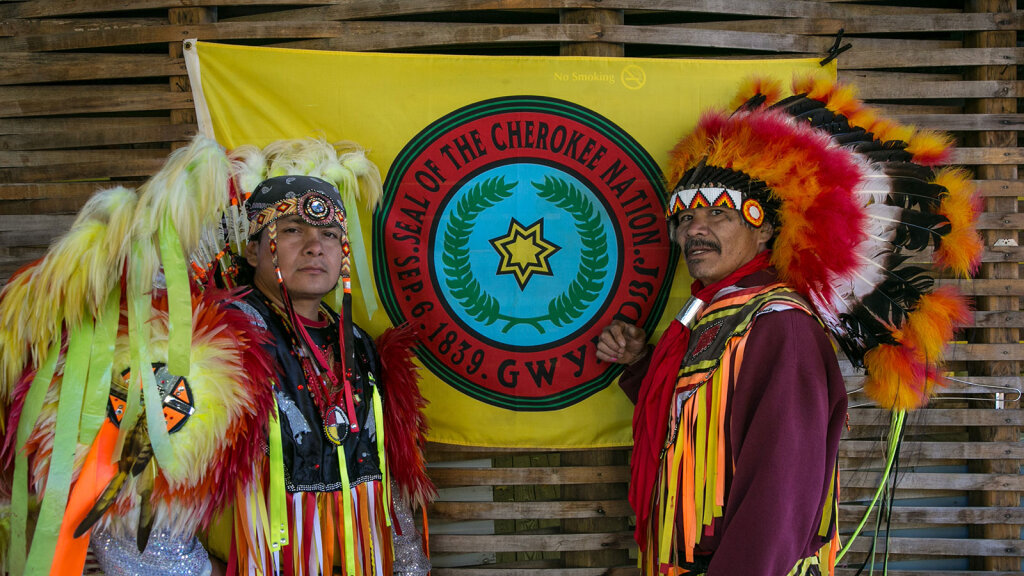
According to a long-term study on the Eastern Band of Cherokee in North Carolina, researchers saw a profound change in the lives of tribe members who received regular casino payments. In 1992, Duke University researchers began to study the effects of poverty on the Cherokee families in Cherokee, North Carolina. When the tribal casino came along, promising to disburse payments to their tribe members, Professor Jane Costello saw the opportunity for a “natural experiment” as a result.
The Eastern Band of Cherokee Native Americans opened a casino in the area, and promised all 15,000 tribal members an equal cut of the profits. The first casino was more of a glorified arcade of slots along a forgotten highway, and the first payments came to a single yearly payment of only $595 for each member of the tribe.
But the casino has grown, and in 2016, every tribal member received around $12,000. The casino also sets aside payments for Cherokee children, to be cashed out when they turn 18. Some young Cherokee adults found over $100,000 waiting for them, enough to fund college education, business interests, or investment in the future.
Online American Casinos
A Bigger Truth
When Professor Jane Costello of the Duke University Center for Child and Family Policy analyzed the results of years of research, she discovered a bigger truth. By studying the long term effects of poverty on children, she found marked improvement in the mental and emotional well-being of Cherokee children whose families received payments of only $4,000 per year.
Professor Costello applied detailed psychological assessments of adolescent Cherokee children and continued the comparisons through adulthood until age 30, and compared these results to children who had never been poor. Children at the poorest levels were prone to violence at home or school, behavioral disorders, anxiety, depression, and substance addiction.
But the children whose families received regular money from the tribal casinos showed a 40% decrease in behavioral problems as well as fewer drug and alcohol issues. When the research began, Costello did not think that the small amounts of casino money would make a difference in what she saw as “such a pit of poverty.”
After witnessing the major changes in the lives of the Cherokee families who received unconditional cash transfers, Costello found evidence of the effects of a larger political experiment: a universal basic income. “I suddenly thought, ‘Oh my god,’” Costello said.
Pay Now or Pay Later
Great American Casino
Professor Costello’s research led to a testimony before the U.S. Senate Committee on Indian Affairs regarding the importance of investing in children. In addition to a decrease in behavioral problems associated with poverty, the Cherokee children who received tribal casino money had fewer teen pregnancies, were more likely to finish high school, and most went on to secure better jobs.
Since the research and the testimony, the current political environment has shifted dramatically toward conservative policies. While the income of the top 1% of Americans has tripled in the past decade, the income of the average family has flatlined.
While a conservative government balks at handing out any form of payment to the poor, society will end up paying for the results of an impoverished population. The costs of rehabilitation, incarceration, and drug addiction are paid by everyone. In her testimony before the Senate Committee, Professor Costello summed it up:
“When it comes to raising children to be independent citizens, we pay now or we pay later.”