- Shapes Out Of Money In The Real World Meaning
- Shapes In Real Life
- Shapes Out Of Money In The Real World
Roy Fields, a Christian musician, has created a viral Facebook video that purports to show the destruction of the World Trade Center towers on September 11, 2001 using folded money. The Latin 'E Pluribus Unum' means 'One out of many' (that is, order out of chaos) which is the foundation of the New World Order's plan to unify the world's governments, religions and money systems into one so the world can be controlled. WHY THE ANTICHRIST MUST COME SOON!!! The capstone has not come down on the Pyramid.
We are surrounded by various geometric shapes all around. The mobile phone that we hold, the computer screen that we watch, and the bed on which we sleep, all are geometric in shape. Snakes and ladder, which is one of the most played childhood games, is played with the help of dice, which, in turn, is a cube.
Cube is a 3-dimensional structure with six squares/faces, and three of them meet at each vertex, and all the angles at the corner are right-angled.
Let’s see the relevant examples of the cube in everyday life.
1. Ice Cubes
As soon as summers arrive, we begin to stock our freezers with ice cube trays. It might be a bit hard to survive the scorching heat without dunking a handful of ice cubes to cool our drinks.
2. Dice
Dice are used all over the world for various games. A rolling dice never fails to render excitement and tension, be it at home with family at the dinner table or at the casino. Playing dice games is fun for all ages. There are dots on every side, which range from one in number to six.
3. Sugar Cubes
Two cubes of sugar, please! It is what we usually say when we are asked the amount of sugar for our coffee. Sugar in the cube form is just fascinating. Sugar is the most used sweetener in our daily life.
4. Rubik Cube
The Rubik cube is the best-selling and one of the most interesting toys in history. It was discovered to explain the 3-dimensional geometry of a cube. It even won the award of “Toy of The Year” in 1980-1981.
5. Old Iron Lockers
We have seen the stealing scenes in movies and daily soaps; how the thief steals the money and jewellery kept in the cubic locker. Such kinds of antique cubic lockers are mostly found in the homes of rich people, which they use to keep their jewellery, money, and other expensive items.
6. Gift Box
Cube gift box is considered as one of the most formal and interesting gift boxes to be present to others.
7. Cube Building Blocks
Most of us, in our childhood, have often played a game where we tried to build a tomb or tower using small blocks. These are cubical in shape because their shape gives them structural stability.
8. Ice Cube
An ice cube is a cube-shaped piece of frozen water. Water has the property by virtue of which it can take the shape of the container in which it is poured. The most common mould or tray used to manufacture ice is the cubic ice tray. This makes ice cubes one of the most popular examples of cube-shaped objects present in our daily life.
9. Carton Boxes
Carton boxes, we all need a lot of them while shifting our stuff from one place to the other. Carton boxes are made up of cardboard and are available in a number of sizes. The two most popular geometric shapes used by carton manufacturing companies are a cube and a cuboid.
Shapes Out Of Money In The Real World Meaning
10. Lego Blocks
Lego is one of the most popular construction toys. It consists of a number of interlocking plastic building blocks that are used to construct fun shapes and artefacts. Some of the Lego pieces are cubical in shape. Hence, Lego building blocks are yet another example of cubical objects used in daily life.
11. Chocolate Cubes
The cube shape can be observed in real life by looking at a bar of chocolate that consists of a number of cubical blocks interconnected to each other. Also, some of the chocolates are originally manufactured in the shape of a cube.
12. Rooms
If the magnitude of the length, width, and height of a room is the same, then such a room is said to be cubical in shape. Because it consists of 6 faces, 8 vertices, and 12 edges. Hence, the room you are sitting in is itself might be an example of cube-shaped objects in real life.
Basic economic activities like buying and selling, otherwise known as trade or commerce, dates back thousands of years. However, in ancient times, there was no common medium of exchange like currencies. Goods and services were exchanged through the barter trade. But, this type of trade could not be sustained and led to several losses, especially for those who exchanged more valuable items for less ones. Hence, there was a need for a universally accepted buying and selling means. Around 600 BC, the first currency, the Mesopotamian shekel, appeared in Lydia (present-day Turkey).
What Is A Currency?

In general terms, a currency is a money in any form used as a medium of exchange, especially in coins and banknote forms. Money can be defined as any legal tender issued by the government and accepted as a payment for goods or services offered, taxes, and debt repayment. Thus, a currency is a monetary unit used by the buyer to obtain goods or services from a seller. Most countries have their currencies. Thus, a country may not use its currency in another country unless it is converted to the local currency at an exchange rate. However, two or more countries can use one currency. For instance, Nineteen EU member states use a common currency known as the euro (€).
Currency Classification
Currencies can be classified into three monetary systems; representative, commodity, and fiat money. Representative money is money printed on paper representing the value of an item or commodity. For instance, a gold certificate representing the value of gold one has. Commodity money is money in the form of other items such as gold or silk, which can be used in buying other goods. Fiat money is a currency issued by the government and not pegged on any commodity. Another form of currency gaining popularity is virtual currency, a digital, unregulated currency issued and controlled by the developer. Examples include Litecoin and Bitcoin.
Popular Currencies
Almost every country has a unique currency, although some countries share common currencies. Currently, about 180 currencies are used across the globe and recognized by the United Nations. However, not all the currencies have equal strength or value; some are stronger and trade frequently in the foreign exchange markets. The Kuwaiti dinar is the world’s strongest and highest valued currency. It is also the world’s most valuable currency, with its strength and value attributed to Kuwait’s oil resources.
Shapes In Real Life
The US dollar (US$) is the most used and trade currency. It is considered the world’s chief reserve currency held by most commercial and central banks globally. Besides the US, 22 other countries use different forms of the dollar currency, including Australia and Canada. The Euro currency (€) is used by 19 of the 27 EU member states, making it one of the currencies used by most countries. Pound sterling (£) is the oldest currency still in use and the UK’s official currency. Other powerful currencies include the Japanese Yen (¥) and the Indian Rupee (₹)
Why Countries Need Currencies
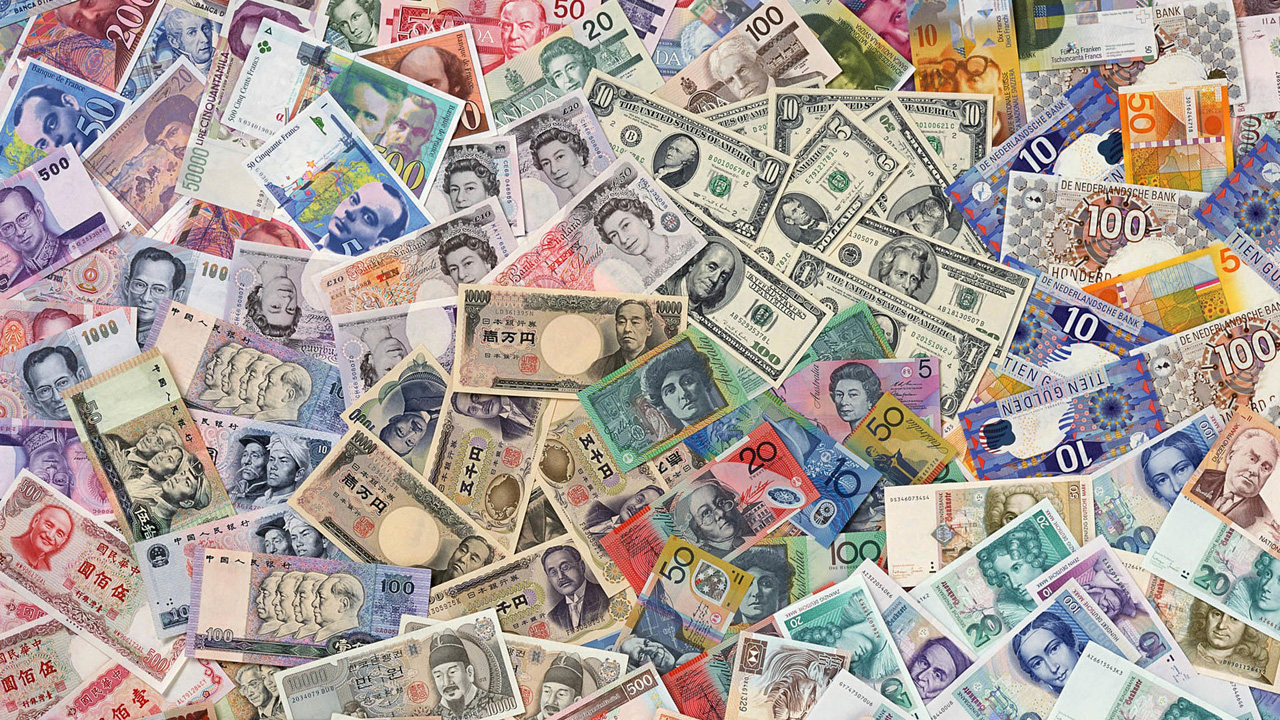
Almost every country trades with other countries either within their regions or overseas. Some countries trade more than others. In most cases, barter trade is not practical, so money is used in such circumstances. However, countries have different types of currencies or money with different units of account. Therefore, they cannot buy goods from another country using the local currencies. The most common solution to this problem is currency exchange.
Currency is important to a country because of the exchange rate. Nations use their foreign currency reserves to fix exchange rates to become competitive in the export market, improve investor confidence, and remain liquid during a crisis. Currency reserves are also required to offset external debts and fund diverse sectors of the economy.
| Country | Currency | Sub Currency |
|---|---|---|
Afghanistan | afghani | 100 puls |
Algeria | dinar | 100 centimes |
Andorra | euro | 100 cents |
Argentina | peso | 100 centavos |
Australia | dollar | 100 cents |
Austria | euro | 100 cents |
Bahamas | dollar | 100 cents |
Bahrain | dinar | 1,000 fils |
Barbados | dollar | 100 cents |
Belgium | euro | 100 cents |
Belize | dollar | 100 cents |
Benin | franc | 100 centimes |
Bolivia | boliviano | 100 centavos |
Brazil | real | 100 centavos |
Brunei | dollar | 100 cents or sen |
Bulgaria | lev | 100 stotinki |
Cameroon | franc | 100 centimes |
Canada | dollar | 100 cents |
Cayman Islands | dollar | 100 cents |
Central African Rep. | franc | 100 centimes |
Chad | franc | 100 centimes |
Chile | peso | 100 centavos |
China | yuan | 10 fen |
Colombia | peso | 100 centavos |
Congo | franc | 100 centimes |
Costa Rica | colon | 100 centimos |
Cuba | peso | 100 centavos |
Cyprus (Greek) | euro | 100 cents |
Cyprus (Turkish) | lira | 100 kurus |
Czechoslovakia | koruna | 100 halers |
Denmark | krone | 100 ore |
Djibouti | franc | 100 centimes |
Dominican Rep. | peso | 100 centavos |
Ecuador | dollar | 100 cents |
Egypt | pound | 100 piastres |
El Salvador | colon | 100 centavos |
Ethiopia | birr | 100 cents |
Fiji | dollar | 100 cents |
Finland | euro | 100 cents |
France | euro | 100 cents |
Gabon | franc | 100 centimes |
Gambia | dalasi | 100 bututs |
Germany | euro | 100 cents |
Ghana | cedi | 100 pesewas |
Greece | euro | 100 cents |
Guatemala | quetzal | 100 centavos |
Guinea | franc | 100 centimes |
Guyana | dollar | 100 cents |
Haiti | gourde | 100 centimes |
Honduras | lempira | 100 centavos |
Hong Kong | dollar | 100 cents |
Hungary | forint | 100 filler |
Iceland | Krona | 100 aurar |
India | rupee | 100 paise |
Indonesia | rupiah | 100 sen |
Iraq | dinar | 1,000 fils |
Ireland | euro | 100 cents |
Israel | shekel | 100 agorot |
Italy | euro | 100 cents |
Ivory Coast | franc | 100 centimes |
Jamaica | dollar | 100 cents |
Japan | yen | 100 cen |
Jordan | dinar | 1,000 fils |
Kenya | shilling | 100 cents |
Kuwait | dinar | 1,000 fils |
Lebanon | pound | 100 piastres |
Luxembourg | euro | 100 cents |
Malawi | kwacha | 100 tambala |
Malaysia | ringgit | 100 sen |
Maldives | rufiyaa | 100 laari |
Malta | euro | 100 cents |
Mauritania | ouguiya | 5 khoums |
Mauritius | rupee | 100 cents |
Mexico | peso | 100 centavos |
Mongolia | tugrik | 100 mongo |
Montenegro | euro | 100 cents |
Morocco | dirham | 100 centimes |
Nepal | rupee | 100 paisa |
Netherlands | euro | 100 cents |
New Zealand | dollar | 100 cents |
Nicaragua | cordoba | 100 centavos |
Niger | franc | 100 centimes |
Norway | krone | 100 ore |
Oman | riyal-omani | 1,000 baiza |
Pakistan | rupee | 100 paisa |
Papua New Guinea | kina | 100 toea |
Paraguay | guarani | 100 centimos |
Peru | inti | 100 centimes |
Philippines | peso | 100 centavos |
Poland | zloty | 100 groszy |
Portugal | euro | 100 cents |
Qatar | riyal | 100 dirhams |
Romania | leu | 100 bani |
Russia | ruble | 100 kopeks |
Rwanda | franc | 100 centimes |
Saudi Arabia | riyal | 100 halalas |
Senegal | franc | 100 centimes |
Serbia | dinar | 100 paras |
Seychelles | rupee | 100 cents |
Sierra Leone | leone | 100 cents |
Singapore | dollar | 100 cents |
Slovakia | koruna | |
Slovenia | euro | 100 cents |
Solomon Islands | dollar | 100 cents |
Somalia | shilling | 100 cents |
South Africa | rand | 100 cents |
South Korea | won | 100 chon |
Spain | euro | 100 cents |
Sri Lanka | rupee | 100 cents |
Sudan | dinar | |
Suriname | guilder | 100 cents |
Sweden | krona | 100 ore |
Switzerland | franc | 100 centimes |
Syria | pound | 100 piastres |
Taiwan | dollar | 100 cents |
Tanzania | shilling | 100 cents |
Thailand | baht | 100 satang |
Togo | franc | 100 centimes |
Trinidad & Tobago | dollar | 100 cents |
Tunisia | dinar | 1,000 millimes |
Turkey | lira | 100 kurus |
Uganda | shilling | 100 cents |
Ukraine | hryvnia | 100 kopiyka |
United Arab Emir. | dirham | 1,000 fils |
United Kingdom | pound | 100 pence |
United States | dollar | 100 cents |
Uruguay | peso | 100 centesimos |
Venezuela | bolivar | 100 centimos |
Vietnam | dong | 100 xu |
Western Samoa | tala | 100 sene |
Zambia | kwacha | 100 ngwee |
Zimbabwe | dollar | 100 cents |
Shapes Out Of Money In The Real World
Note: currencies often change value without notice