- How To Check If Money Is Real With Marker
- How To Test If Money Is Real With A Marker Name
- How To Test If Money Is Real With A Marker Line
- How To Test If Money Is Real With A Markers
- How To Test If Money Is Real With A Marker Sign
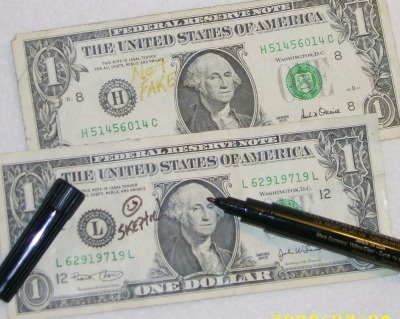
A counterfeit banknote detection pen is a pen used to apply an iodine-based ink to banknotes in an attempt to determine their authenticity.
The counterfeit bill detector will mark gold when the money is authentic, and the marker will mark it a clear black when the bill is fake. Overall I highly recommend these counterfeit pen. They are marked at a great price, and you get 5 of them! One fake bill and these bill pens have done their job. Counterfeit banknote detection pens are used to detect counterfeit Swiss franc, euro and United States banknotes, amongst others. Typically, genuine banknotes are printed on paper based on cotton fibers and do not contain the starches that are reactive with iodine. When the pen is used to mark genuine bills, the mark is yellowish or colourless. Because real money is printed on linen and cotton paper, the ink remains clear or slightly yellow. If a bill is printed on wood-based paper, the ink reacts and turns dark. Some pens come with a coil cord so you can keep them attached to your cash register. Tests For: Correct paper.
Background[edit]
Counterfeit banknote detection pens are used to detect counterfeitSwiss franc, euro and United States banknotes, amongst others. Typically, genuine banknotes are printed on paper based on cotton fibers and do not contain the starches that are reactive with iodine. When the pen is used to mark genuine bills, the mark is yellowish or colourless.
Such pens are most effective against counterfeit notes printed on a standard printer or photocopier paper.[1] The chemical properties of US banknotes before 1960 make marking pens useless.[2] One example of this complication taking place happened in 2016, in which a 13 year-old student was arrested by police after she attempted to pay for lunch with a red seal Series 1953 $2 bill after the school's counterfeit pen was unable to prove its authenticity.[3]
Reception[edit]
Pen manufacturers claim such pens will detect a great majority of counterfeit bills and are an easy counterfeit detection method that does not require expensive gadgets.[citation needed]
Critical reception[edit]
Critics suggest the effectiveness is much lower. Critics claim that professional counterfeiters use starch-free paper, making the pen unable to detect the majority of counterfeit money in circulation.[4] Magician and skeptic James Randi has written about the ineffectiveness of counterfeit pens on numerous occasions[5][6] and uses a pen as an example during his lectures.[7] Randi claims to have contacted a United States Secret Service inspector and asked whether the pen works as advertised, to which the inspector replied 'it is not dependable.'[5] The Secret Service does not include such pens in their guidelines for the public's detection of counterfeit US currency.[8]
US counterfeiters bleach small denominations and print more valuable bills on the resulting blank paper to evade this test,[9] although changes to the currency since 2004 have made this method easier to detect. This is one reason that many currencies use different sized notes for different denominations.
False positives[edit]
The effectiveness of the pens may be affected by external methods. Simply having a banknote pass through laundry, depending on the soaps and bleaches used, can cause a bill to fail the test when it is otherwise accepted. Additionally, it was discovered that treating a counterfeit note with a dilute solution of vitamin C will cause a false negative: that is, it will respond to the iodine-based ink as though it were made of the same paper as a valid banknote.[10]
See also[edit]
References[edit]

- ^'How does a counterfeit detector pen work? 123'. HowStuffWorks. Retrieved 2008-03-28.
- ^'OLD PAPER MONEY AND COUNTERFEIT-DETECTING PENS'. The E-Sylum. December 9, 2007.
- ^'Lunchroom Lunacy: ISD cops investigate $2 bill spent on school lunch'. abc13.com. Retrieved Jul 15, 2019.
- ^Shermer, Michael (January 2004). 'Bunkum!'. Scientific American. Archived from the original on 2013-02-02. Retrieved 2008-03-28.Alt URL
- ^ abRandi, James (2004-12-03). 'Commentary'. Swift. James Randi Educational Foundation. Retrieved 2008-03-28.
- ^Randi, James (2005-07-01). 'Commentary'. Swift. James Randi Educational Foundation. Retrieved 2008-03-28.
- ^Rowley, Erin (2008-03-27). 'Paranormal skeptic addresses crowd'. The Daily Collegian. Retrieved 2008-03-28.
- ^'Know Your Money - Counterfeit Awareness'. United States Secret Service. Archived from the original on 2007-10-23. Retrieved 2007-11-06.
- ^Swallow, Natalie (2008-03-12). 'Businesses Lose out on Counterfeit Money'. Springfield, Missouri: KSPR. Archived from the original on 2008-04-05. Retrieved 2008-03-28.
- ^Abdullah Beydoun (20 July 2017). 'How do Counterfeit Pen Tests Work?'. Banknote World Resource Hub.
How To Check If Money Is Real With Marker
Many people who work with cash on a regular basis develop a feel for the difference between legitimate and counterfeit money. Others may receive an occasional bill in change that simply doesn't feel right. There are a number of ways to tell if money is counterfeit, but it helps to recognize the safeguards and counter-measures built into legitimate paper currency as well. Even the most sophisticated counterfeiter is likely to miss something.
Real money is generally printed on special paper with a high amount of cotton fiber. This allows paper currency to be folded several thousand times without tearing. In many cases, counterfeiters use a cheaper form of bond paper that is not nearly as durable. If the paper is not treated properly, the ink will bleed into the fibers and create blurred or blotchy images. A visual inspection between a suspicious bill and a known bill should reveal any obvious printing errors or paper quality differences.
Another way to tell if money is counterfeit is to look for special security measures built into real paper currency. Holding the bill up to a light source should reveal a watermark, essentially a shadow image depicted in the center. This watermark is created during the paper making process and cannot be duplicated by a photocopier. The lack of a discernible watermark should be an indication the money is fake.
How To Test If Money Is Real With A Marker Name
How To Test If Money Is Real With A Marker Line
In US currency, there should also be an embedded security strip that denotes the denomination of the bill. This is another anti-counterfeiting measure added to the bill during the printing process and cannot be seen in reflective light. By holding the bill up to a light source, you should be able to see and read the strip along one side. This process of implanting a plastic foil strip into the actual paper took almost a decade to perfect, so counterfeiters would have a very difficult time duplicating it without the specialized equipment.
Many places, such as grocery stores, retail outlets, and restaurants, that deal with large amounts of cash have other ways to tell if money is counterfeit. A pen loaded with a special reactive ink can be swiped across a suspicious bill to determine if it is real or fake. If a visible mark appears, the money is considered legitimate. If the mark remains invisible, this indicates the paper has not been treated with the proper chemicals and is most likely counterfeit. These pens can be purchased at many office supply stores for personal use as well.
How To Test If Money Is Real With A Markers
Real US currency also contains special inks that change color when viewed at different angles. If a suspected bill's government seal and other denominational indicators do not change from black to green when viewed at an angle, the bill may very well be counterfeit. Even the most sophisticated photocopiers or offset printers can have trouble reproducing extremely fine print, so an examination of a bill under a magnifying glass should reveal small letters hidden within the background scrolls and images. If these microscopic letters are missing or unreadable, the bill is most likely counterfeit.
How To Test If Money Is Real With A Marker Sign
There are other ways to tell if a particular bill is counterfeit or not, but it may simply be safer to turn suspicious money over to law enforcement officers or bank officials for further investigation. In general, counterfeiters tend to concentrate their efforts on larger denominations, such as $10s, $20s, $50s, or $100s in US currency. Small purchases made with exceptionally large currencies may be an effort to launder a counterfeit bill by receiving legitimate change, for example. This is a red flag for many retailers, so don't be surprised if your own larger bills are examined very closely when making cash purchases.